
Not every health concern needs an emergency department, but deciding where to go can feel uncertain when you’re unwell. If you’re looking for a walk in doctor winnipeg residents can turn to for a non-emergency concern, start by considering what you need assessed and how urgent it feels.
You may be wondering whether a clinic can assess your symptoms, what information to bring, or how a walk-in visit differs from seeing a family doctor. This guide explains how to prepare, what kinds of care may be available, and how walk-in services fit into primary care at Sage Creek Medical Center in Southeast Winnipeg.
We’ll also cover when a concern calls for emergency care instead. Sage Creek Medical Center brings walk-in services together with family medicine and an on-site pharmacy, providing local care for patients and families at different stages of life.
Key Takeaways
- A walk in doctor winnipeg visit can assess a non-emergency concern. The clinician’s recommendations depend on your symptoms and health history.
- Walk-in care focuses on a current health need, while family medicine supports ongoing care. Emergency services are for severe or potentially life-threatening situations.
- Walk-in services can be part of a broader primary-care setting that includes women’s health, pediatric care, immunizations, chronic disease management, and minor procedures.
- Before your visit, review the clinic’s current instructions and gather identification, Manitoba Health information when applicable, medication names, allergies, and relevant health details.
- Sage Creek Medical Center provides walk-in services alongside family medicine and an on-site pharmacy. Follow the clinic’s current instructions to plan your visit.
What Can a Walk-In Doctor in Winnipeg Help With?
A walk-in doctor can assess a current health concern even if you don’t have an established relationship with that physician. At Sage Creek Medical Center, walk-in care is part of a broader primary-care setting. The clinician considers the concern you bring and discusses appropriate next steps.
In brief: Walk-in care focuses on a health need you want assessed now. Family medicine supports care over time, including preventive care and ongoing health concerns. During a walk-in visit, the clinician considers your symptoms, relevant medical history, and individual circumstances. They may recommend further assessment or follow-up, depending on what they find.
When might a Winnipeg walk-in doctor be a helpful first step?
A walk-in visit may be suitable for a new, non-emergency concern you’d like a physician to assess. Examples include a minor illness, a new symptom, or a straightforward health question. Not every issue can be resolved in one visit. After considering your concern and health history, the clinician determines what assessment or follow-up is appropriate.
Walk-in clinics are commonly understood as a form of urgent care for health needs that require attention but aren’t emergencies. To make your concern easier to assess, be ready to explain when symptoms began, how they have changed, and what else you have noticed.
What is the difference between walk-in care and family medicine?
Walk-in care centres on the health need you bring to that visit. Family medicine is relationship-based and supports your health over time, including preventive care and ongoing concerns such as chronic conditions. A walk-in assessment can address a current question, but it doesn’t replace continuity with a family physician when you need regular monitoring or coordinated care.
Sage Creek Medical Center offers walk-in services alongside family medicine, women’s health, pediatric care, immunizations, chronic disease management, and minor procedures. This broader primary-care setting serves patients and families at different life stages. If you’re looking for ongoing care, the guide How to Find Family Doctors in Winnipeg Accepting New Patients: A Step-by-Step Guide can help you explore that pathway.
What Health Concerns Can a Walk-In Doctor Assess?
A walk-in physician assesses the concern you bring and recommends next steps based on your symptoms, health history, and clinical assessment. A visit can provide medical advice, but it doesn’t guarantee a particular diagnosis, prescription, test, or treatment. If you’re searching for a walk in doctor winnipeg residents can visit, first consider whether your need is immediate, preventive, or part of ongoing follow-up.
Common reasons people seek walk-in medical care
A physician may assess a new or changing non-emergency concern, such as a cough, rash, mild pain, or urinary discomfort. Explain when it began, what has changed, and any other symptoms you have noticed. These details give the clinician useful context when deciding whether further assessment or follow-up is appropriate.
Walk-in care can also connect with preventive and primary-care needs. At Sage Creek Medical Center, services include women’s health, pediatric care, immunizations and vaccinations, and minor procedures. The clinician considers your individual circumstances when assessing whether a particular concern is suitable for a walk-in visit. For appointment preparation tips, see the National Institute on Aging’s Preparing for a Doctor’s Appointment.
Follow-up needs vary. A clinician may assess a concern and recommend what to do next. Ongoing or complex health conditions may benefit from continuity with a family physician. A walk-in visit does not guarantee every issue can be addressed in one appointment.
When should you seek emergency help instead?
For severe or life-threatening symptoms, such as serious difficulty breathing, severe chest pain, or sudden signs of a stroke, call 911 or seek emergency care. A walk-in clinic is not a substitute for emergency response. For more help choosing between care pathways, read Walk-In Clinic vs ER: Where to Go in Winnipeg.
If your concern is non-emergency and you’d like to learn about local primary-care options, visit Sage Creek Medical Center.
Walk-In Doctor, Family Physician, or Emergency Care: Which Fits?
The right care pathway depends on how urgent your concern is and whether you need a one-time assessment or care over time. If you’re looking for a walk in doctor winnipeg residents can see, use this comparison as a starting point, not a diagnosis. A clinician can recommend appropriate next steps after assessing your situation.
| Care pathway | Best suited to | Continuity |
|---|---|---|
| Walk-in assessment | A current, non-emergency health concern that needs medical assessment. | Usually focused on the concern at that visit. Follow-up may be recommended. |
| Family physician | Preventive care, ongoing health questions, and chronic or complex conditions. | Supports an ongoing relationship, follow-up, and care planning over time. |
| Emergency department or 911 | Severe or potentially life-threatening symptoms that need emergency attention. | Provides emergency assessment and response, rather than routine ongoing care. |
Walk-in care or an ongoing family physician?
A walk-in visit can help address a current concern, particularly when you need an assessment but don’t have an established family doctor. Ongoing family medicine is different: a physician can build familiarity with your health history and support follow-up over time.
That continuity can be especially helpful for chronic conditions, complex health needs, and preventive care. A walk-in assessment may still be useful for a new issue, but it shouldn’t replace regular follow-up when that’s needed. If you’re looking for a regular doctor, see How to Find Family Doctors in Winnipeg Accepting New Patients: A Step-by-Step Guide.
Walk-in clinic or emergency department?
Walk-in care is not a substitute for emergency services. If symptoms are severe, rapidly worsening, or potentially life-threatening, call 911 or seek emergency care. Serious difficulty breathing, severe chest pain, and sudden signs of a stroke are examples of symptoms that require emergency attention.
For concerns that aren’t emergencies, a walk-in clinic may be an appropriate place to seek assessment. The clinician will consider your symptoms and health history, then advise whether further care is needed. For a fuller comparison of these options, read Walk-In Clinic vs ER: Where to Go in Winnipeg.
How to Prepare for a Walk-In Doctor Visit in Winnipeg
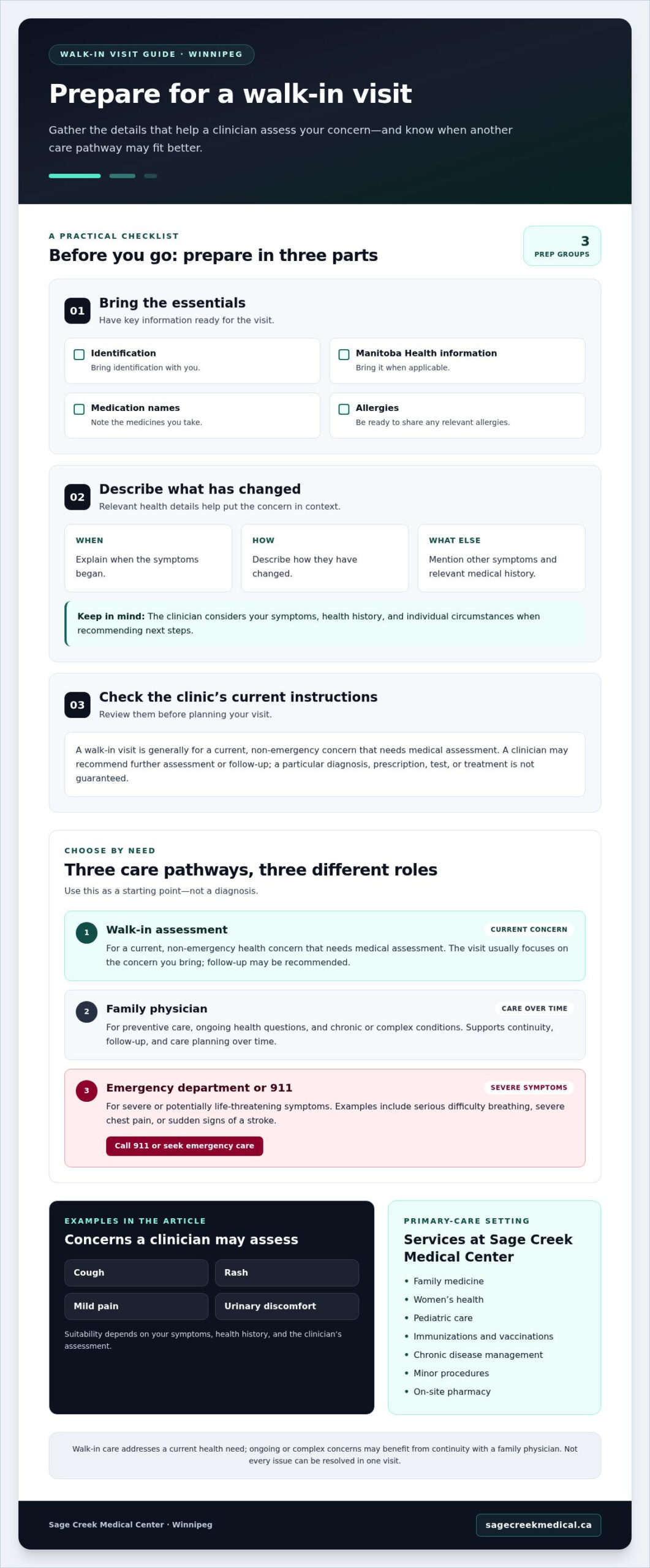
A little preparation can make it easier to explain what’s going on and get the most from your visit. If you’re searching for a “walk in doctor winnipeg,” review the clinic’s current visit instructions before travelling and gather the health details that relate to your concern. Follow those instructions rather than assuming a particular appointment or arrival process.
What information should you bring to a walk-in visit?
Use this short checklist to get ready:
- Review current visit instructions. Follow the clinic’s guidance on how to access a visit before you leave.
- Gather identification and health information. Bring identification and your Manitoba Health information, if applicable. Having this information with you doesn’t guarantee coverage.
- Note relevant health details. Write down medication names, allergies, past diagnoses, and relevant medical records or test results, if available.
- Make a brief symptom timeline. Record when the concern began, how it has changed, and any details that seem relevant. Note your main question for the physician, too.
Keep your notes concise. A few key points can help you remember what you wanted to discuss, especially if you’re feeling unwell or anxious.
How can you make the appointment conversation easier?
Start with your main concern, then describe what you’ve noticed in clear, specific terms. Explain when symptoms began, whether they’re improving or worsening, and how they affect your usual activities. Share relevant medical history and mention medication or allergy information that may matter to the assessment.
Ask what follow-up the physician recommends and what changes or warning signs should prompt you to seek further care. If you’d like support during the conversation, a trusted person may be able to accompany you when appropriate and permitted by the clinic.
Before heading out, review Sage Creek Medical Center’s current visit instructions. Having your key information ready can help the physician understand your concern and discuss appropriate next steps with you.
Getting Walk-In Care at Sage Creek Medical Center
For Winnipeg residents looking for a walk in doctor winnipeg option, Sage Creek Medical Center provides walk-in services alongside broader primary care in a community-focused setting. The clinic offers care for current concerns as well as services that support health needs over time. At each visit, the clinician reviews the concern and relevant health information, then discusses appropriate care or follow-up.
What care can patients access at Sage Creek?
Sage Creek Medical Center offers walk-in care within a wider range of primary-care and preventive services. Depending on the need, patients and families can access services such as:
- Women’s health services and pediatric care
- Chronic disease management and preventive care
- Immunizations and vaccinations
- Minor procedures
- Family medicine consultations
These services address different needs, from a current concern to ongoing health care. A clinician assesses each situation individually and discusses suitable next steps. A walk-in visit doesn’t guarantee that every concern can be resolved in one appointment, and follow-up may be recommended when appropriate.
An on-site pharmacy provides prescription dispensing and free city-wide delivery. Having pharmacy services in the same setting can make prescription follow-up more convenient. For details about care and the clinic, explore care at Sage Creek Medical Center.
How can you take the next step?
Before travelling, follow the clinic’s current visit and registration instructions. These explain how to access a visit and what steps to take. Reviewing them in advance can help you arrive prepared, although it doesn’t guarantee access at a particular time.
Bring health information related to your concern, such as medication names, allergies, and a short note about when symptoms began or changed. You can also write down the main question you want to discuss. Clear details help the clinician understand what’s happening and explain possible next steps.
If Sage Creek’s local, patient-centred approach fits your care needs, visit Sage Creek Medical Center to review current information and visit instructions.
Choose the Care That Fits Your Needs
The right care pathway depends on your concern. Walk-in care can assess a current, non-emergency need, while a family physician supports ongoing care and follow-up. Severe or potentially life-threatening symptoms call for emergency help. Before visiting, review the clinic’s current instructions and bring relevant health details, including medication names, allergies, and a brief symptom timeline.
If you’re looking for a walk in doctor winnipeg residents can access alongside broader primary care, Sage Creek Medical Center offers walk-in services and family medicine in one local setting. Its on-site pharmacy provides prescription dispensing and free city-wide delivery, adding convenience to prescription follow-up.
Take the next step by exploring care at Sage Creek Medical Center and reviewing the current visit information. Preparing a few key details can help you discuss your concern and understand what comes next.
Frequently Asked Questions
Can I see a walk-in doctor in Winnipeg without a family physician?
Yes. You can seek a walk-in assessment without having a family physician. Walk-in services address a current concern without requiring an established relationship with that doctor. If you searched “walk in doctor winnipeg,” follow Sage Creek Medical Center’s current visit instructions to access care. A walk-in visit doesn’t automatically establish ongoing family-medicine care or make the physician your regular family doctor.
What should I bring to a walk-in doctor appointment in Winnipeg?
Bring identification and your Manitoba Health information, if applicable. It can also help to have a list of your medications and allergies, relevant medical history, and any records related to your concern. Write down when symptoms began and what has changed, along with the questions you want answered. The physician will consider these details as part of an assessment, but they don’t guarantee a particular test, prescription, or outcome.
Can a Winnipeg walk-in doctor refill a prescription?
A physician may review a refill request as part of your assessment, but a prescription isn’t guaranteed. The decision depends on the medication, your clinical history, and the physician’s judgment. Bring the medication name and dosage, or the packaging if you have it, and ask about a refill before you run out when possible. Sage Creek Medical Center has an on-site pharmacy for prescription dispensing.
Is a walk-in clinic the same as an emergency room?
No. A walk-in clinic assesses non-emergency health concerns, while emergency services respond to severe or potentially life-threatening situations. If someone may be in immediate danger, call 911 or seek emergency care rather than waiting for a routine clinic visit. A physician’s assessment helps determine appropriate next steps for non-emergency concerns. For more local guidance, see the “Walk-In Clinic vs ER: Where to Go in Winnipeg” guide.
Does Manitoba Health cover a walk-in doctor visit?
Coverage depends on the service, your eligibility, and current Manitoba rules. Medically necessary consultations may be insured for eligible patients, but not every service provided in a medical setting is necessarily covered. Some services may carry a fee. Review current Manitoba Health guidance for coverage details and Sage Creek Medical Center’s information about uninsured services to understand what may apply to your situation.
Can a walk-in doctor help with a chronic condition?
A walk-in physician can assess a concern related to a chronic condition and discuss appropriate next steps. Bring relevant medical history, medication details, and notes about recent changes so the clinician has useful context. A walk-in visit may address an immediate question, but it may not replace ongoing follow-up with a family physician, particularly when regular monitoring or coordinated care is part of your needs.
When should I go to a walk-in clinic instead of calling 911?
A walk-in clinic may be appropriate for a non-emergency concern that needs medical assessment. Call 911 if a person faces a severe or potentially life-threatening emergency or needs immediate help. Don’t delay emergency care to seek routine clinic access or use an online checklist to diagnose the situation. For a non-emergency concern, follow Sage Creek Medical Center’s current visit instructions before travelling.